

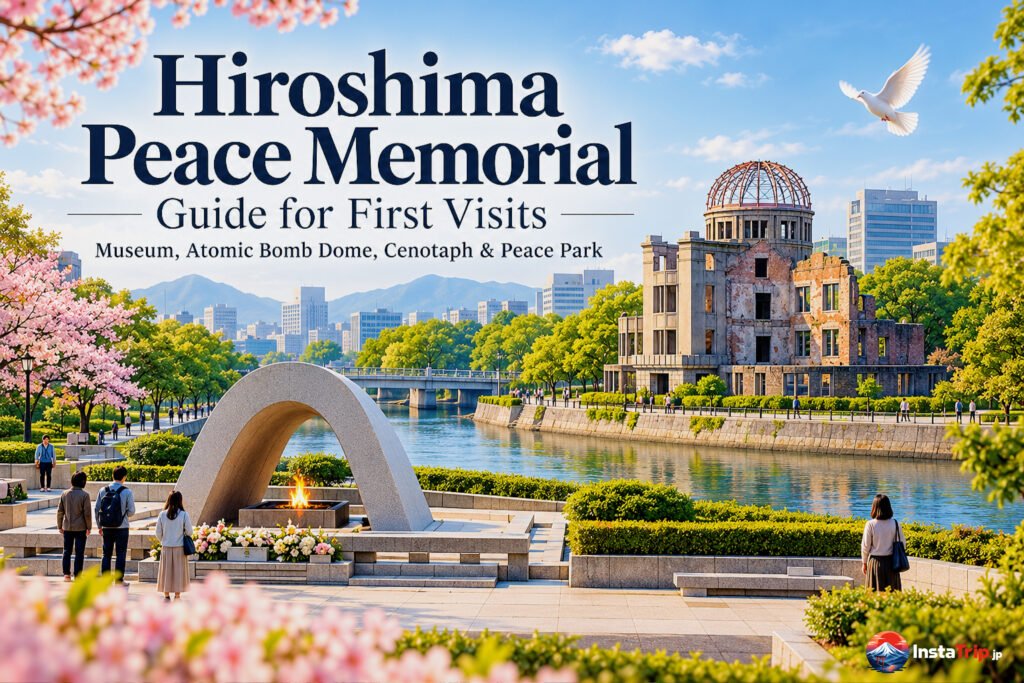
Hiroshima’s Peace Memorial Park is not a landmark to rush between lunch and a train departure. It is a landscape of remembrance at the heart of a vibrant, forward-looking city, where river light, school groups, flowers, and carefully preserved ruins create space for reflection. This Hiroshima peace memorial guide helps you experience its central sites with context, practical clarity, and the attention they deserve.
Begin with the story of the city
At 8:15 a.m. on August 6, 1945, an atomic bomb was detonated above Hiroshima, causing catastrophic destruction and immense loss of life. The effects did not end that morning. Survivors, known as hibakusha, lived with injuries, illness, grief, discrimination, and the lifelong work of sharing what they had experienced.
The area now known as Peace Memorial Park stood close to the bomb’s hypocenter, once a busy commercial and residential district. After the war, Hiroshima chose to shape this devastated ground into a public space devoted to peace. That decision gives the park its unusual emotional force: it is at once a memorial, a civic landscape, an architectural statement, and a living gathering place.

Approach it not as an attraction to collect, but as a place to listen. A meaningful visit can be quiet and personal, yet it is also an encounter with testimony that asks visitors to consider the human consequences of war.
The essential Hiroshima Peace Memorial sites
The park is walkable, and its major landmarks are best understood as parts of one carefully composed experience. Allow at least two to three hours if you plan to visit the museum with care. Half a day is more comfortable if you want time to sit, read the inscriptions, and explore nearby streets afterward.
Hiroshima Peace Memorial Museum
For most visitors, the museum is the emotional center of the Hiroshima Peace Memorial experience. Its permanent exhibits present the events of August 6 through personal belongings, photographs, survivor accounts, models, and historical interpretation. A damaged lunchbox, a child’s clothing, or a handwritten message can carry more weight than any statistic.
The museum does not make for light viewing, and it should not. Its power comes from the specificity of individual lives rather than spectacle. Give yourself time to read selectively instead of attempting to absorb every panel at speed. If you are traveling with children or are sensitive to difficult material, consider the emotional intensity beforehand and allow time afterward to decompress in the park.

Visitor numbers can be high, particularly during peak travel seasons and around August 6, Hiroshima Peace Memorial Ceremony day. An earlier arrival often provides a calmer atmosphere. Photography rules can vary by gallery, so follow posted guidance and avoid treating solemn displays as backdrops for social media.
The Atomic Bomb Dome
Across the Motoyasu River, the Atomic Bomb Dome is one of Japan’s most recognizable monuments. Formerly the Hiroshima Prefectural Industrial Promotion Hall, its skeletal brick-and-steel frame survived near the hypocenter. It was preserved as a visible reminder of the destruction rather than rebuilt or erased.
Seen from the riverbank, the Dome can appear almost unreal against Hiroshima’s modern buildings and passing streetcars. That contrast is part of its meaning. The city did not remain frozen in 1945, but it has kept this fragment of the past in view. Walk around the perimeter, observe the barrier, and respect restrictions that protect the structure. You cannot enter it.
The best photographs are rarely the closest ones. Step back toward the bridge or along the riverside path to frame the dome within the broader cityscape. More importantly, pause before taking a picture. The site is a memorial, not an abandoned building chosen for atmosphere.
The Cenotaph and the Flame of Peace
At the park’s central axis stands the Memorial Cenotaph for the Atomic Bomb Victims. Its saddle-shaped arch shelters a stone chest holding the names of those who died as a result of the bombing. The arch was designed to evoke sheltering souls, while the aligned view beyond it leads toward the Flame of Peace and the Atomic Bomb Dome.
This visual line is among the most memorable scenes in Hiroshima. It connects mourning, a commitment to abolish nuclear weapons, and the enduring physical evidence of the blast. The Flame of Peace has burned since 1964 and is intended to remain alight until the world is free of nuclear weapons.
Spend a few minutes here rather than simply photographing the view. You may see visitors bow, leave flowers, or stand in silence. There is no prescribed ritual for international guests, but calm, considerate behavior is always appropriate.
Children’s Peace Monument and the Peace Bell
The Children’s Peace Monument honors the many children who died from the bombing and its aftermath. It was inspired by Sasaki Sadako, a young girl who developed leukemia years after the attack and folded paper cranes while hoping for recovery. Today, brightly colored chains of cranes sent from schools and communities around the world surround the monument.
The cranes are moving because they are not decorative objects. They represent remembrance, hope, and the way Hiroshima’s story continues to be shared across generations. Take a close look at the messages attached to them, but do not touch displays or leave items unless you understand the site’s current guidelines.
Nearby, the Peace Bell invites visitors to ring it. The gesture can be meaningful, but it is best made gently and without turning it into a performance. In a park shaped by so many intimate losses, restraint adds dignity to the experience.
A respectful way to plan your visit
There is no single correct route, but beginning at the museum gives many visitors the clearest historical foundation. From there, walk through the park to the Cenotaph, Flame of Peace, Children’s Peace Monument, and the Atomic Bomb Dome. Crossing the river at the end can offer a natural moment to look back across the memorial landscape.
Morning brings softer light and, often, less crowd pressure. Late afternoon can be equally beautiful, especially when the rivers and trees soften the surrounding city, though museum entry times may limit how long you can stay inside. Check current hours and any temporary exhibition information before setting out, as schedules can change.
Dress for a substantial amount of walking, especially in Hiroshima’s humid summers or cool, windy winters. The park is largely open-air, with limited shade in some areas. Bring water in warm weather, keep your phone on silent, and avoid eating as you walk around the principal memorials.
If you are joining a guided experience, look for one that emphasizes historical context and survivor testimony rather than hurried photo stops. Independent travelers can have an equally powerful visit with a little preparation. Reading the museum’s introductory material slowly and allowing unplanned time in the park are often more valuable than packing in extra stops.
What to do after the memorial
A visit to Peace Memorial Park can leave you quiet, unsettled, or emotionally exhausted. That response is understandable. Hiroshima, however, is not defined only by tragedy. The city’s daily life, leafy riverbanks, streetcar network, galleries, baseball culture, and celebrated okonomiyaki offer another essential part of its story: renewal without forgetting.
For a contemplative continuation, walk along the Motoyasu River or spend time in the surrounding downtown streets at an unhurried pace. If you choose to try Hiroshima-style okonomiyaki afterward, the lively, layered dish can feel like a welcome return to the present. It is not about forcing cheerfulness after a difficult visit. It is about recognizing that Hiroshima is a living city, shaped by memory but full of energy and ordinary human warmth.
The perspective to carry with you
The Hiroshima Peace Memorial is magnificent in neither a decorative nor triumphant sense. Its significance lies in how architecture, testimony, and open space make an overwhelming history tangible without reducing it to a single image. You will leave with facts, but the enduring impression may be smaller: the paper cranes moving in the breeze, names held beneath the cenotaph, the dome standing across the water.
Let those details stay with you as you continue through Japan. They offer a deeper way to see Hiroshima – not as a chapter closed in the past, but as a city that has chosen remembrance, dialogue, and peace as part of its living identity.
![[商品価格に関しましては、リンクが作成された時点と現時点で情報が変更されている場合がございます。]](https://hbb.afl.rakuten.co.jp/hgb/57566020.2d1a940f.57566021.21352c7d/?me_id=1431225&item_id=10001080&pc=https%3A%2F%2Fthumbnail.image.rakuten.co.jp%2F%400_mall%2Ff341002-hiroshima%2Fcabinet%2F12711847%2Frtc003_01.jpg%3F_ex%3D128x128&s=128x128&t=picttext "[商品価格に関しましては、リンクが作成された時点と現時点で情報が変更されている場合がございます。]")