
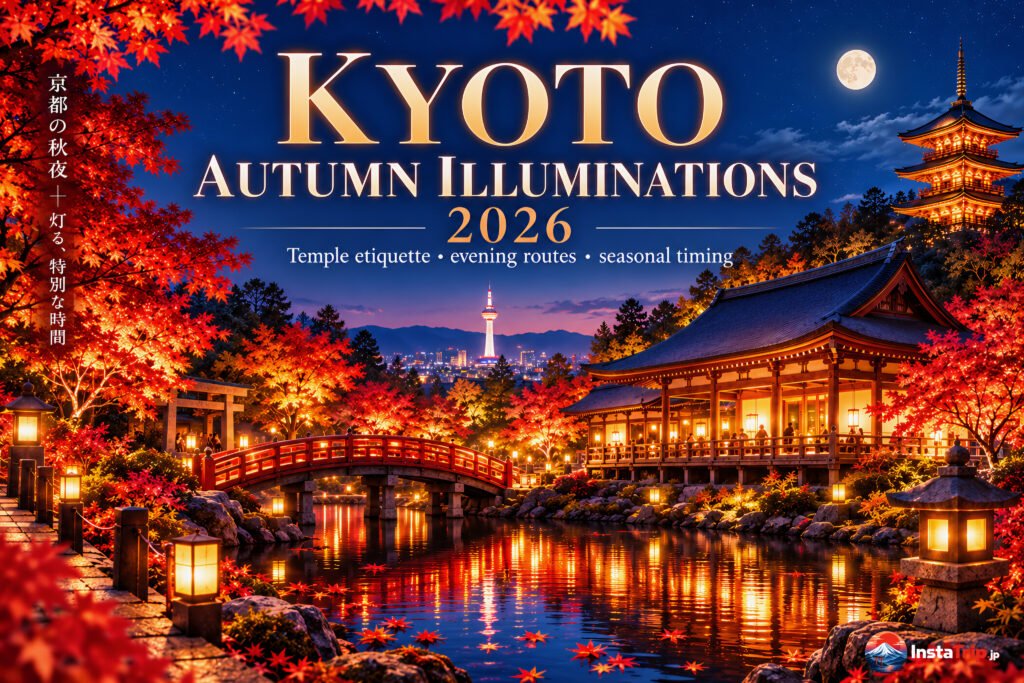
Kyoto after sunset in late autumn is not simply a city with prettier leaves. It becomes a sequence of carefully framed scenes: vermilion gates glowing against the dark, temple roofs reflected in still ponds, and maple canopies lit from below like stained glass. For travelers planning Kyoto autumn illuminations 2026, the real appeal lies in this meeting of seasonal beauty, historic architecture, and the contemplative atmosphere of Kyoto’s temple grounds.
Known in Japanese as kōyō, autumn foliage has long been appreciated as a fleeting seasonal expression. Illumination events extend that experience into the evening, revealing familiar gardens, paths, and halls in an entirely different character. The effect can be magnificent, but it also requires thoughtful planning. These events are popular, weather-dependent, and often held at sacred sites where respectful behavior matters as much as getting the photograph.
When to Expect Kyoto Autumn Illuminations 2026
Kyoto’s peak autumn color usually arrives from mid-November through early December, although the exact timing shifts each year with temperature, rain, and wind. Illuminations commonly begin in early or mid-November and continue into late November or early December. Some major sites run longer, while others offer only a limited series of evening openings.

For 2026, treat published schedules as provisional until each temple, garden, or attraction confirms its dates, hours, admission rules, and reservation procedures. Japan’s foliage forecasts become more useful as fall approaches, but they are still forecasts, not guarantees. A warm autumn can delay peak color; a spell of rain or strong wind can shorten it dramatically.
If your itinerary allows flexibility, plan two possible illumination evenings rather than building your entire Kyoto visit around one. The best date is not always the official peak. A garden with a mix of green, gold, scarlet, and deep red can be every bit as captivating as a fully crimson hillside, especially under theatrical lighting.
The Temple Experiences That Define the Season
Kyoto’s best-known night openings are concentrated around temples and gardens that already possess extraordinary architecture, water features, or elevated views. Rather than trying to see everything, choose one or two places whose atmosphere suits the kind of evening you want.

Eikandō: Maple Color in a Temple Garden
Eikandō, formally Zenrin-ji, is among Kyoto’s most celebrated autumn destinations. Its grounds are known for a generous concentration of maples, and the night illumination gives the temple’s ponds, bridges, and layered hillsides a rich, cinematic depth. It is a particularly strong choice for travelers who want foliage to be the central experience rather than a backdrop to the city.
Expect crowds at popular times, especially on clear weekend evenings. Arriving near opening can offer more breathing room than joining the late-evening rush, though conditions vary. Take time to look beyond the brightest leaves: the quieter shadows around wooden halls and the reflections on Hojo Pond are part of the experience.
Kiyomizu-dera: A Vast View Above Eastern Kyoto
Kiyomizu-dera is one of Kyoto’s defining landmarks, and its special autumn evening openings are designed on a grand scale. From the temple’s famous wooden stage, the illuminated hillside spreads below while the city glimmers in the distance. A beam of light projected upward from the main hall is traditionally associated with Kannon’s compassion, adding a spiritual dimension to the visual spectacle.
The trade-off is obvious: Kiyomizu-dera is exceptionally popular. The approach through Higashiyama can be crowded before and after the visit, so leave extra time and avoid treating it as a quick stop between dinner reservations. Its scale makes it unforgettable, but a smaller temple may feel more intimate if quiet is your priority.
Kōdai-ji: Designed Light and Zen Atmosphere
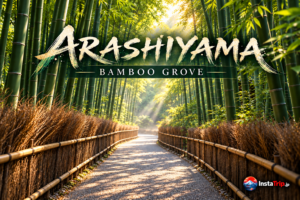
Near Kiyomizu-dera, Kōdai-ji offers a different kind of evening. Its refined gardens, bamboo grove, and carefully composed pathways often make it feel more immersive than panoramic. The temple is closely connected to Kita-no-Mandokoro, the widow of the powerful late 16th-century leader Toyotomi Hideyoshi, and its grounds carry both historical resonance and artistic finesse.
Kōdai-ji’s illumination programs may include contemporary lighting or projection elements. Some visitors love this vivid contrast between traditional garden design and modern visual art; others prefer the more natural, restrained lighting found elsewhere. It depends on whether you want a meditative temple night or a more dynamic interpretation of Kyoto’s heritage.
Tōfuku-ji and the Southern Kyoto Option
Tōfuku-ji is famous for the dramatic maple valley seen from the Tsūtenkyō Bridge. When special autumn viewing is offered, the scale of the foliage can be breathtaking. However, access rules and evening programs can differ from year to year, and some areas may have separate admission or restricted routes.
This is a valuable choice for travelers staying near Kyoto Station or exploring Fushimi Inari Taisha earlier in the day. Check the 2026 details closely before committing, especially if the illumination itself is the reason for your visit. Daytime autumn viewing at Tōfuku-ji can also be exceptional, so it works well as a flexible alternative.
Build an Evening Route, Not a Checklist
A memorable illumination night in Kyoto is usually built around one anchor site. Begin with an unhurried dinner or an early walk through Gion or Higashiyama, visit one temple during its evening opening, then let the journey back become part of the experience. Stone lanes, noren curtains, lantern-lit entrances, and the cool November air give Kyoto’s eastern districts a quiet drama after dark.
Trying to squeeze three major illuminations into one night often means spending more time in taxi lines, buses, and crowds than in the gardens themselves. Kyoto’s buses can be packed during peak foliage season, and some areas become slow-moving after sunset. Walking is often the most rewarding way to connect nearby sights, but wear shoes suited to slopes, uneven paving, and potentially damp paths.
For a calmer route, choose a temple outside the busiest Higashiyama corridor and pair it with a neighborhood meal. For an iconic first visit, accept the energy around Kiyomizu-dera or Kōdai-ji and allow the entire evening to unfold at a slower pace.
Practical Details for an Autumn Night
Illuminations frequently require a separate admission fee from daytime entry, and daytime tickets do not automatically carry into the evening. Some sites clear the grounds between sessions. Confirm the last admission time, not just the official closing time, because gates can close well before the lights are switched off.
Bring a light outer layer even if the afternoon was mild. Kyoto evenings in November can feel sharply cooler in temple gardens, where you may spend time standing still. A compact umbrella is sensible, but avoid blocking pathways or views with it in crowded areas.
Photography is welcome at many outdoor sites, yet rules differ. Tripods, drones, flash, and commercial-looking equipment may be prohibited or impractical in dense crowds. More importantly, do not step beyond marked paths, lean over barriers for a reflection shot, or hold up a procession of visitors. The strongest images often come from pausing, lowering the camera, and noticing where the light meets water, wood, and leaves.
Respecting Sacred Places After Dark
An illumination event may feel like an art installation, but many venues are active Buddhist temples with spaces for worship and daily religious life. Dress neatly, speak softly, follow one-way routes, and observe posted guidance around halls, gates, and photography. If incense, prayer areas, or visitors in worship are present, give them room.
This respect is not separate from the experience. Kyoto’s autumn nights are powerful precisely because light is placed within living cultural landscapes, not on anonymous scenery. A lantern-lit eave, a garden pond, and a temple bell carry meanings shaped by centuries of devotion, craftsmanship, and seasonal attention.
For Kyoto autumn illuminations 2026, leave room for the unplanned moment: a side street scented with roasted tea, a sudden shower that sharpens every reflection, or a single red maple branch glowing above an old wooden gate. Those pauses are often what turn an evening itinerary into a lasting memory of Kyoto.
![[商品価格に関しましては、リンクが作成された時点と現時点で情報が変更されている場合がございます。]](https://hbb.afl.rakuten.co.jp/hgb/574e2132.47e6b7eb.574e2133.4456a8ff/?me_id=1385906&item_id=10006785&pc=https%3A%2F%2Fthumbnail.image.rakuten.co.jp%2F%400_mall%2Ff261009-kyoto%2Fcabinet%2Fr_travel_cp%2F261000_rtc016.jpg%3F_ex%3D128x128&s=128x128&t=picttext "[商品価格に関しましては、リンクが作成された時点と現時点で情報が変更されている場合がございます。]")