
The first light over Kyoto’s tiled rooftops, the hush beneath Nikko’s towering cedars, the steam rising from an onsen town in Hokkaido – these moments are why Japan stays with travelers long after they return home. Sustainable tourism Japan is about protecting the conditions that make those moments possible: living neighborhoods, sacred landscapes, local livelihoods, and the everyday rhythms that cannot be staged for visitors.
This does not mean a trip must be stripped of excitement or limited to remote places. Japan’s magnificent cities, celebrated temples, vibrant food halls, and high-speed rail are part of the experience. It means traveling with enough awareness to see beyond the checklist and leave a place with its character intact.
What Sustainable Tourism in Japan Really Means
Sustainability is often reduced to reusable bottles and tote bags. Those choices are worthwhile, but in Japan, thoughtful travel also has a cultural dimension. A shrine is not simply a beautiful backdrop. A narrow lane in Gion is not an open-air set. A local train is not merely transportation between attractions. These are active parts of community life, shaped by etiquette, history, and the people who use them every day.

The pressure of tourism is uneven. Tokyo has the scale and transit network to absorb large numbers of visitors, though individual neighborhoods can still become crowded. Kyoto faces a different challenge, particularly around famous temples and historic districts. Smaller destinations may welcome visitors enthusiastically while lacking the staffing, waste systems, or transport frequency to handle sudden peaks. Sustainable decisions begin with recognizing that Japan is not one single visitor experience.
The goal is not to avoid popular places out of guilt. Sensō-ji, Fushimi Inari Taisha, Nara Park, and the streets of Shinjuku deserve their global appeal. The better question is how to experience them in a way that respects their purpose and spreads the benefits of travel more widely.
Make Time Part of Your Travel Plan
When everyone follows the same itinerary at the same hour, even extraordinary places can feel overwhelmed. Shifting your schedule is one of the simplest ways to travel more responsibly while gaining a richer experience.
Visit major landmarks early in the morning or later in the afternoon when appropriate, rather than arriving at peak midday. Stay for an evening meal in the area instead of treating a historic district as a quick photo stop. In Kyoto, for example, an unhurried visit to a temple can be paired with a craft museum, a neighborhood café, or a walk along a quieter canal. The city becomes more than a sequence of famous gates and viewpoints.
Seasonality matters, too. Cherry blossom season and autumn foliage are captivating, but they concentrate visitors into short periods. Winter can reveal another side of Japan: clear air around Mount Fuji, luminous city illuminations, snow-covered temples, and warm regional food. Early summer brings lush gardens and hydrangeas, while late spring and early fall often offer comfortable conditions with a little more breathing room.
Traveling outside peak dates is not always possible, especially for families or travelers with fixed vacation time. If your dates are set, choose a slower pace. One meaningful activity in a neighborhood can have more value than rushing through five headline attractions.
Let Local Spending Tell a Better Story
Where you spend money has a direct effect on the places you visit. An independent ryokan, family-run minshuku, local guide, neighborhood restaurant, or regional craft workshop keeps more of a travel budget connected to the community. It also opens a more personal window into Japan’s regional character.
This does not mean international hotel brands or convenience-store meals are somehow wrong. They can be practical, reliable, and sometimes exactly what a traveler needs. The balance matters. If you stay at a large hotel in Tokyo, consider booking a small-group walking tour in Yanaka or buying ceramics directly from a studio in Kappabashi. If you visit Hakone for its celebrated hot springs and views of Mount Fuji, make room for a locally made meal or a museum rooted in the area’s artistic identity.
Regional travel offers especially meaningful opportunities. Kanazawa’s craft traditions, Tottori’s dramatic dunes, the volcanic landscapes of Kyushu, Okinawa’s distinct island culture, and Hokkaido’s vast natural settings each offer reasons to extend a journey beyond the Tokyo-Kyoto-Osaka route. These places should not be treated as lesser-known alternatives simply because they are quieter. They are complete destinations with their own histories, flavors, and pace.
Travel Gently Through Cities and Landscapes
Japan’s rail system makes lower-impact travel remarkably practical. The shinkansen turns long distances into part of the adventure, passing cityscapes, rice fields, mountains, and coastlines in a single day. Local trains and buses can take you deeper into the texture of a region, although they require patience and planning.
For some rural areas, a rental car may be the most realistic choice. That is especially true where buses are infrequent or when traveling with family, luggage, or limited time. Sustainable travel is not about choosing the most difficult option. It is about choosing thoughtfully: combine stops efficiently, avoid unnecessary driving, follow parking rules, and do not pull over on narrow roads for an unplanned photo.
On foot, travelers have an equally important role. Keep pathways clear, especially around station entrances and narrow shopping streets. Carry your trash until you find an appropriate bin or return it to your accommodation, since public trash cans are limited in many areas. Japan’s clean streets are supported by shared habits, not by a promise that someone else will clean up after visitors.
Nature requires particular care. Stay on marked trails, respect closures, and avoid taking plants, stones, or other natural objects as souvenirs. At beaches, forests, and mountain viewpoints, the most memorable photographs are rarely worth damage to a fragile place or disruption to those around you.
Respect Places That Are Still Lived In
Japan’s cultural landmarks are often active religious sites, working markets, residential streets, and places of remembrance. Their beauty is inseparable from their continued use.
At shrines and temples, observe signs about photography, quiet areas, and access. Follow the behavior of those around you rather than assuming every ritual must be copied. A small donation, when appropriate, can be a respectful gesture, but reverence is shown more clearly through patience, modest conduct, and attention to the space.
The same care belongs in residential areas. Do not enter private lanes, block doorways, or photograph people without permission. In neighborhoods where geiko and maiko traditions are part of the local cultural fabric, visitors should resist treating performers or residents as props for social media. Admiration becomes respectful when it allows people to move through their own city without being interrupted.
Food culture benefits from the same mindset. Try regional specialties, learn what a dish represents, and make reservations when a small restaurant requires them. If a counter has only a few seats, arriving on time and following the house rules is a simple form of consideration. Japan’s dining culture can be wonderfully informal in one setting and carefully ritualized in another. Reading the room is part of the experience.
Choose Experiences Over Consumption
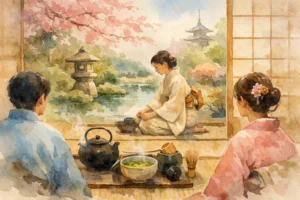
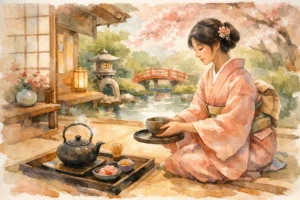
The most sustainable souvenir is often a memory connected to skill, place, and conversation. A tea ceremony, an indigo-dyeing class, a regional cooking lesson, or a visit to an artist’s studio can create a deeper bond than a bag of mass-produced items. If you buy something, choose pieces you will genuinely use or treasure, and ask before photographing workshops or artisans at work.
This approach also changes how an itinerary feels. Rather than collecting destinations, you begin noticing details: the sound of a hand plane in a woodworking shop, the seasonal sweets in a Kyoto confectionery, the quiet precision of a garden path, or the local dialect heard at a morning market. Japan’s fascination lies not only in spectacle, but in the care often visible in ordinary things.
A thoughtful journey does not have to be perfect. Flights, packed schedules, and limited budgets all involve trade-offs. What matters is choosing curiosity over consumption, patience over urgency, and respect over convenience whenever you can. Leave space in your itinerary for a place to surprise you – then let your presence become a small, positive part of its continuing story.