
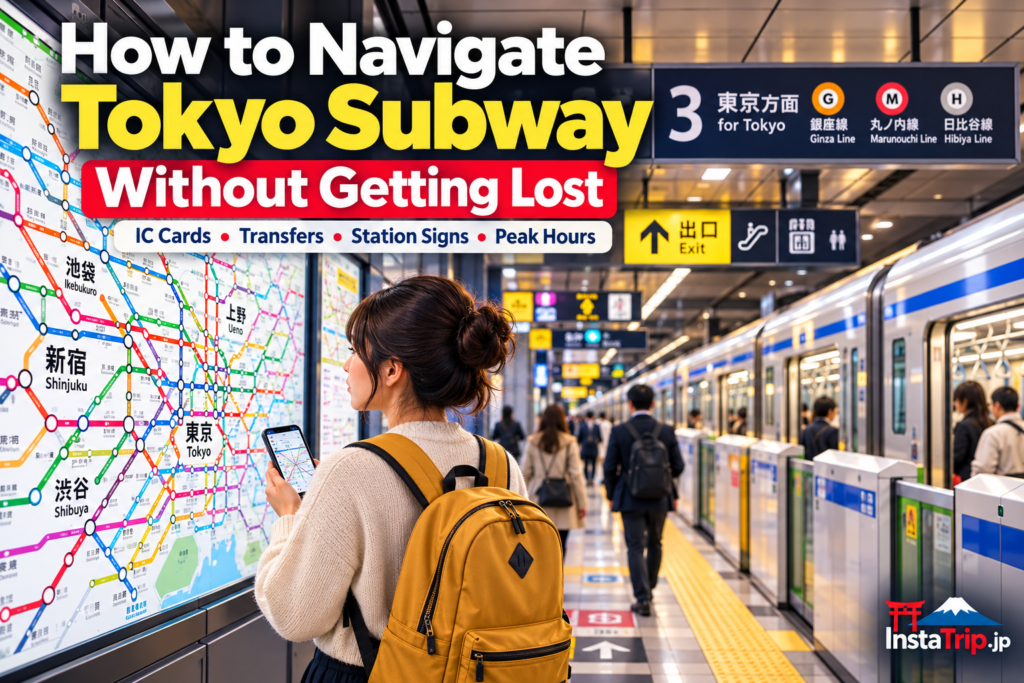
Tokyo’s subway can look overwhelming on a map, but using it is much easier than it appears. Once you understand the colors, station codes, ticket gates and a few Japanese words, the network becomes one of the fastest and most enjoyable ways to explore the city.
This guide explains how to navigate Tokyo subway step by step—from choosing a route and tapping through the gates to making transfers, reading signs and finding the correct exit. You do not need to read Japanese fluently. A handful of kanji, a route app and a little attention are enough.
First, know what “subway” means in Tokyo
The Japanese word for subway is 地下鉄 (ちかてつ / chikatetsu). Tokyo’s subway system is operated by two networks: Tokyo Metro and Toei Subway (都営地下鉄). Together they run 13 subway lines across the city.
Tokyo Metro operates nine lines, while Toei operates four: the Asakusa, Mita, Shinjuku and Oedo lines. They connect with JR East and numerous private railways, so a route-planning app may combine different operators in a single journey.

The famous JR Yamanote Line is extremely useful for Tokyo, but it is not a subway line. Think of Tokyo’s transport system as one connected web rather than separate worlds.
Use colors, letters and station numbers
You do not need to memorize dozens of station names. Each subway line has a color, a letter and numbered stations. The Ginza Line, for example, uses the letter G; the Marunouchi Line uses M.
A station code such as G09 gives you two instant clues: the line and your position on it. If you are moving from G19 toward G09, the numbers should decrease as you travel. This is one of the simplest ways to confirm that you boarded in the correct direction.
When entering a station, look for 駅 (えき / eki), meaning “station,” and follow the line color and symbol shown on overhead signs.
How to navigate Tokyo subway with Google Maps or another route app
For most visitors, the easiest method is to enter the exact destination in a route app rather than trying to solve the entire rail map yourself.
A good route result will normally show:
- the departure station and entrance;
- the line name and color;
- the direction or terminal station;
- the platform number when available;
- where to transfer;
- the recommended exit;
- the estimated fare and travel time.
Pay particular attention to the direction. A platform sign may identify a train by the final station in that direction, not by your own destination. If you need the Ginza Line from Ueno toward Shibuya, follow signs for the Shibuya direction.
Also remember that the fastest route is not always the easiest. With luggage, children or limited mobility, one simple transfer can be better than two faster transfers through a giant interchange such as Shinjuku or Otemachi.
Watch: a practical Tokyo subway walkthrough
This visual guide covers the rail map, Tokyo’s major transport networks, route planning, payment, train displays and basic etiquette—useful before your first ride.
Use an IC card for the easiest ride
An IC card such as Suica or PASMO makes everyday travel much simpler. At the ticket gate, tap the card or compatible phone when entering and again when leaving. The correct fare is calculated automatically.
The Japanese word you will see around ticket gates is 改札 (かいさつ / kaisatsu) or 改札口 (かいさつぐち / kaisatsuguchi), meaning “ticket gate.”
Paper tickets are still available from multilingual machines. If a paper ticket does not cover the full fare, look for a fare adjustment machine before exiting.
Tokyo Subway Ticket: when a pass can save money
If you plan to ride Tokyo Metro and Toei Subway repeatedly, the Tokyo Subway Ticket can be good value. As of 2026, the adult prices are ¥1,000 for 24 hours, ¥1,500 for 48 hours and ¥2,000 for 72 hours. The ticket covers all Tokyo Metro and Toei Subway lines during its validity period.
It does not cover JR trains or most private railways, so compare your itinerary before buying one. If your day mixes subway rides with JR or private lines, an IC card is often the more flexible choice.
Check the latest Tokyo Subway Ticket details on Tokyo Metro’s official website.
Japanese subway words worth recognizing
You do not need to study Japanese before visiting Tokyo, but recognizing these words makes stations far less intimidating:
| Japanese | Reading | Meaning |
|---|---|---|
| 地下鉄 | chikatetsu | subway |
| 駅 | eki | station |
| 改札 / 改札口 | kaisatsu / kaisatsuguchi | ticket gate |
| 入口 | iriguchi | entrance |
| 出口 | deguchi | exit |
| 乗り換え | norikae | transfer |
| 優先席 | yūsen-seki | priority seat |
| 終電 | shūden | last train |
You will also constantly see ホーム (hōmu), the Japanese word commonly used for a railway platform.
Read the signs, not the crowd
Tokyo stations are built around visual information. Signs normally combine Japanese and English with colors, arrows, line symbols and station codes. Follow those signs rather than simply following the biggest crowd.
Once on the platform, electronic displays show the next train and destination. Floor markings indicate where to queue. Stand to the side of the doors, let passengers exit first, then board.
Inside the train, screens usually show upcoming stations, transfer lines and the side on which the doors will open. This is especially useful when you are approaching a large interchange.
Transfers: follow 乗り換え
The word for transfer is 乗り換え (のりかえ / norikae). At most stations, transferring simply means following signs toward another line through corridors, escalators or stairs.
Some transfers are surprisingly long. A route that looks like a simple connection on your phone may involve several minutes of walking underground. Large complexes such as Shinjuku, Tokyo, Ikebukuro and Otemachi can feel like small cities.
If the hallway seems endless, keep following the correct line color, letter and arrows. Do not assume you are lost simply because the transfer takes longer than expected.
The exit matters more than you think
In Japanese, 出口 (でぐち / deguchi) means “exit.” Major stations may have many numbered or lettered exits, and choosing the wrong one can leave you several blocks from your destination.
Check the recommended exit before the train arrives. Station maps often list hotels, museums, department stores, streets and landmarks beside each exit.
In Asakusa, the right exit can put you close to Sensō-ji and Nakamise-dori. In Ginza, it can bring you directly onto the district’s main shopping avenues. In Shibuya, it can save you from circling busy streets and elevated tracks while searching for the crossing.
Subway etiquette: small habits that make travel smoother
Tokyo trains run efficiently partly because passengers follow a few simple habits:
- queue at the platform markings;
- let passengers get off before boarding;
- keep phone calls off the train;
- keep bags close to your body in crowded cars;
- avoid blocking doors;
- keep voices low;
- respect 優先席 (ゆうせんせき / yūsen-seki), the priority seating area.
These customs are less about rigid rules than about keeping a dense transport system comfortable for everyone.
Avoid rush hour if your schedule allows
Weekday morning and evening peaks can be extremely crowded. If you are sightseeing and your schedule is flexible, traveling outside the busiest commuter periods makes transfers, luggage and station navigation noticeably easier.
Late at night, remember 終電 (しゅうでん / shūden): the last train. Tokyo does not run a 24-hour subway service, so always check the final connection if you plan to stay out late.
What to do if you get lost
First: do not panic. Getting on the wrong train in Tokyo is usually a small inconvenience, not a disaster.
Get off at the next station, move away from the flow of passengers and check your route again. If you need help, station staff are accustomed to assisting travelers. A polite すみません (sumimasen)—“excuse me”—followed by showing your destination on your phone is often enough.
You can also look for 案内 (あんない / annai), meaning “information” or “guidance,” on signs and information counters.
Tokyo subway: the 30-second survival method
- Search your destination in a route app.
- Confirm the line color and letter.
- Check the train direction.
- Tap through the 改札口.
- Follow the platform number and line signs.
- At transfers, follow 乗り換え.
- Before arrival, check the correct 出口.
That is really the core of it. Tokyo’s subway may be enormous, but it is also highly organized. After a few rides, the map begins to feel less like a maze and more like a key to the city.
Learn the colors. Trust the station codes. Recognize a few kanji. And leave enough time for the occasional wrong turn—because in Tokyo, even a wrong exit can lead to an unexpectedly beautiful street.