
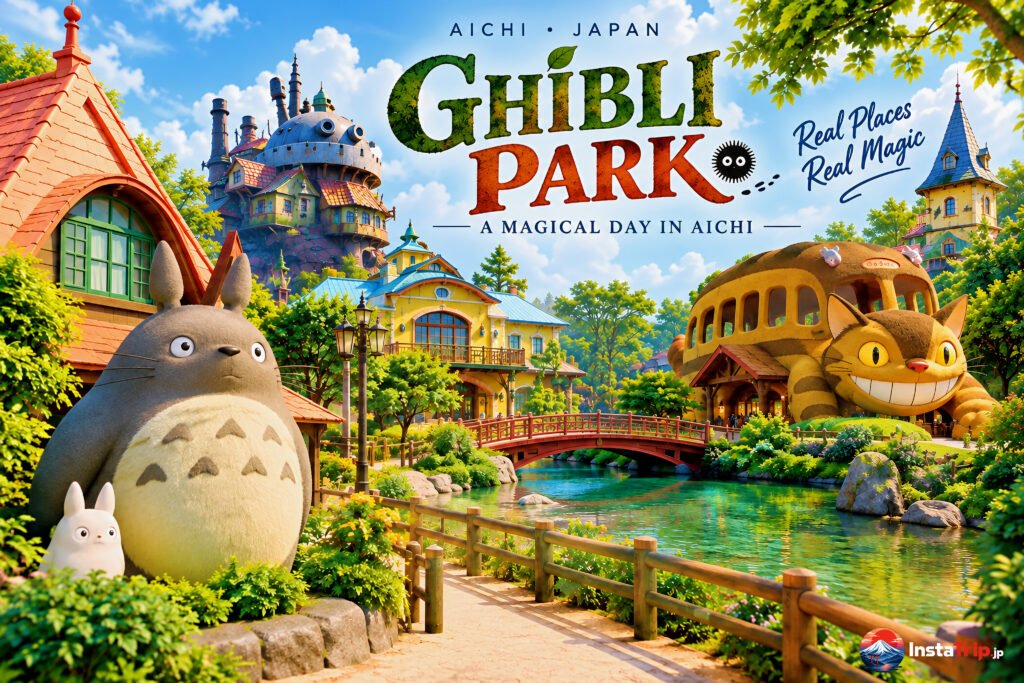
The first surprise in any honest Ghibli Park review is that this is not a conventional theme park. There are no towering roller coasters, parade routes, or costumed characters waiting at every corner. Instead, the park asks visitors to slow down: to open a weathered door, notice a miniature room, walk through a forest, and recognize how carefully ordinary life can become extraordinary.
Set within the expansive greenery of Aichi’s Expo 2005 Commemorative Park near Nagoya, Ghibli Park transforms the imagination of Studio Ghibli into places you can physically enter. It is captivating, playful, and often deeply detailed. It can also feel quieter, more dispersed, and less instantly spectacular than some travelers expect. That difference is precisely what makes it memorable for the right visitor.
What Ghibli Park Feels Like
Ghibli Park is best understood as a collection of story worlds woven into a public park, rather than one enclosed attraction. Its five areas – Ghibli’s Grand Warehouse, Hill of Youth, Dondoko Forest, Mononoke Village, and Valley of Witches – draw from different Studio Ghibli films and visual languages. A gentle walk, local bus ride, or park transit connection can sit between them.

That layout gives the day a refreshing rhythm. You move from indoor wonder to open sky, from nostalgic architecture to wooded paths, rather than spending hours in a single intensely designed zone. On a mild day, the surrounding landscape becomes part of the experience. The changing seasons add their own atmosphere: fresh green in spring, vivid foliage in autumn, and a hushed beauty in cooler weather.
The park’s emotional center is observation. A familiar scene may be recreated with astonishing precision, but the pleasure comes from seeing how it was built: worn floorboards, handwritten details, packed bookshelves, aged tiles, and objects that make a fictional home feel inhabited. It is a celebration of animation as craft, not simply a backdrop for photos.
Ghibli Park Review: The Areas That Stand Out
Ghibli’s Grand Warehouse is the essential stop
For many visitors, Ghibli’s Grand Warehouse is the heart of the park. This vast indoor space brings together exhibitions, small sets, an archive-like atmosphere, playful installations, and spaces inspired by films such as Spirited Away, Arrietty, and The Secret World of Arrietty. It is layered enough to reward curiosity. Look closely and you may find a visual joke, a reference, or a tiny design choice that feels made for longtime fans.

Its greatest strength is variety. One moment feels like a museum devoted to hand-drawn imagination; the next is theatrical, whimsical, or warmly nostalgic. It is also the most weather-proof part of the day, making it especially valuable if rain is in the forecast.
Still, this is where expectations matter most. The Warehouse can be busy, particularly around popular photo spots and narrow interiors. Visitors hoping for an entirely serene, private encounter with Ghibli’s worlds may need patience. Arrive at your designated time, give yourself room to wander without rushing, and let the less obvious corners be part of the experience.
Valley of Witches delivers the biggest visual impact
Valley of Witches is the park’s most vividly cinematic district. Inspired by works including Kiki’s Delivery Service, Howl’s Moving Castle, and Earwig and the Witch, it has a storybook European character expressed through colorful shops, fantastical buildings, and wonderfully eccentric details.
This is the area that feels closest to what many people picture when they hear “Ghibli theme park.” The architecture is expressive, the scale is inviting, and the setting offers some of the park’s most photogenic views. Yet it avoids becoming a generic fantasy village because its details are rooted in the handmade visual language of the films.
It is also one of the most family-friendly areas, though adults who grew up with Ghibli will find just as much to admire. Some attractions and interiors have separate access conditions, so check the ticket details carefully before building your hopes around a specific house or experience.
Dondoko Forest and Mononoke Village reward a slower pace
Dondoko Forest, inspired by My Neighbor Totoro, has a quieter charm. The wooded setting and the re-creation of Satsuki and Mei’s home create a sense of childhood discovery that is more intimate than dramatic. It may be especially meaningful for visitors who value the domestic, rural side of Ghibli storytelling: gardens, old homes, family rhythms, and the mystery waiting just beyond a familiar path.
Mononoke Village takes a different direction, evoking the ancient, elemental atmosphere of Princess Mononoke. It is smaller than some visitors anticipate, but its tactile design and mountain-village mood make it a worthwhile pause. Rather than expecting a vast recreation of the film’s forest, approach it as a compact interpretation shaped by craft traditions and the park’s natural surroundings.
Hill of Youth is also compact, yet its early-20th-century architectural character offers a lovely contrast to the park’s more fantastical spaces. Fans of Whisper of the Heart will appreciate its mood of youthful ambition, romance, and urban nostalgia.
The Ticket Reality: Planning Shapes the Experience
Ghibli Park is not the kind of place where spontaneous entry is a safe plan. Timed admission, area access, ticket categories, sales schedules, and availability can all shape what you are able to see. These policies may change, so travelers should confirm current official information before committing to transportation or accommodations.
The practical question is not only whether you can get a ticket, but what that ticket includes. Some options provide access to more areas or selected interiors, while others may be more limited. Read the details line by line. A lower-priced ticket can still offer a wonderful day, but it may not match an itinerary built around entering a particular building.
Because the park is spread across a large public landscape, it is wise to plan for more time than the map suggests. A visit focused on one or two areas can work well for travelers with a tight schedule. To enjoy several areas without turning the day into a race, allow most of a day and leave breathing room for walking, meals, restrooms, transit, and the occasional unexpected queue.
From central Nagoya, the journey is manageable but not immediate. That makes Ghibli Park an excellent dedicated day trip, rather than an attraction to squeeze between a morning market and an evening reservation. Staying near a convenient rail connection can make the start of the day far more relaxed.
Who Will Love It, and Who May Feel Underwhelmed
Ghibli Park is magnificent for viewers who cherish Studio Ghibli’s visual storytelling, animation history, architecture, and emotional texture. It is equally rewarding for photographers, designers, families, and travelers who enjoy Japanese cultural experiences built around atmosphere rather than adrenaline.
It may be less satisfying for visitors looking for nonstop rides, large-scale spectacle, or a single compact destination with every attraction steps apart. The park does have playful elements and dramatic settings, but it is not designed around thrill-seeking. Its magic often arrives quietly.
Language is another consideration. The spaces are visually accessible, and affection for the films travels easily across borders, but not every label or presentation will offer the same depth in English. For many international visitors, this does not diminish the experience. It simply means the park works best when approached through feeling, visual detail, and curiosity rather than as a fully translated museum exhibition.
Photography rules also differ by location. Some of the most immersive interiors restrict photos to protect the visitor flow and preserve the sense of discovery. Respecting those limits is part of the experience. Put the phone away for a few minutes, and the memory often becomes stronger than another image in the camera roll.
Is Ghibli Park Worth Visiting?
Yes, with the right expectations. Ghibli Park is not a place that tries to overwhelm you. It offers something more thoughtful: an opportunity to step inside the textures, rooms, landscapes, and emotional worlds that made Studio Ghibli so beloved.
The best visit is not measured by how many attractions you complete. It is measured by the small moments you notice: sunlight on a familiar roofline, a room that appears ready for its animated residents to return, the sound of leaves on a path between worlds. Give Ghibli Park time, arrive with curiosity, and let its quiet imagination set the pace.
![[商品価格に関しましては、リンクが作成された時点と現時点で情報が変更されている場合がございます。]](https://hbb.afl.rakuten.co.jp/hgb/0738ba9f.d5863ce9.0738baa0.442f811f/?me_id=1226754&item_id=10003658&pc=https%3A%2F%2Fthumbnail.image.rakuten.co.jp%2F%400_mall%2Fsekaiya%2Fcabinet%2F03203354%2F4170new_3.jpg%3F_ex%3D128x128&s=128x128&t=picttext "[商品価格に関しましては、リンクが作成された時点と現時点で情報が変更されている場合がございます。]")