
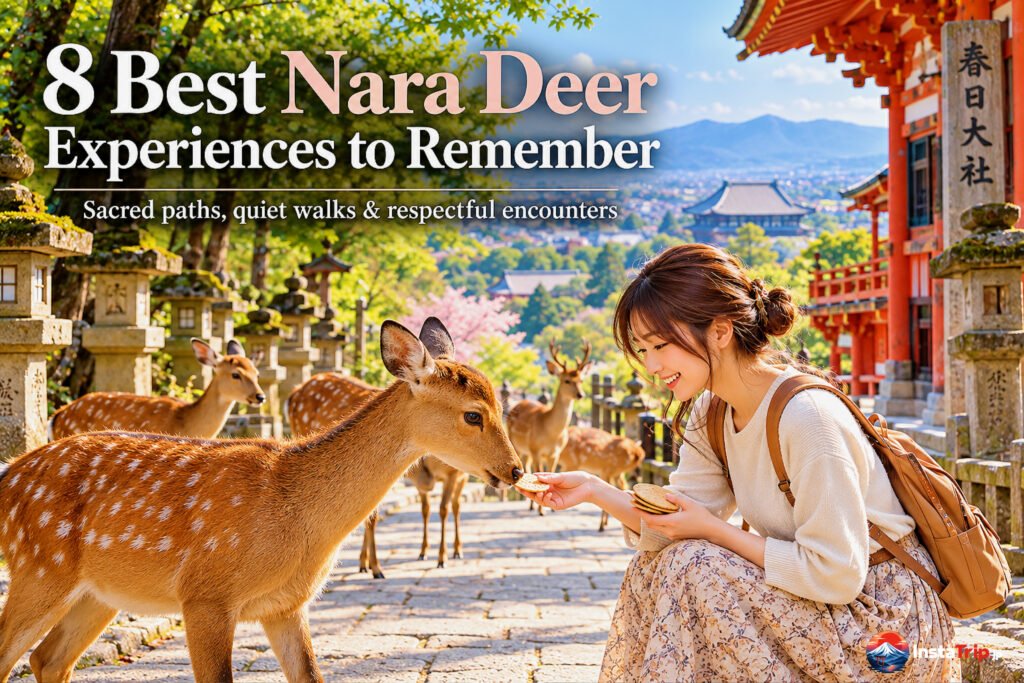
A deer pauses beneath the stone lanterns of Kasuga Taisha, another crosses the wide lawn near Tōdai-ji, and suddenly Nara (奈良市) feels less like a sightseeing stop and more like a living encounter with Japan’s ancient imagination. The best Nara deer experiences are not about collecting the closest possible photo. They are about moving slowly through a former capital where wild sika deer, wooded shrine paths, monumental temples, and daily city life have shared the same landscape for centuries.
Nara’s deer are often described as messengers of the gods because of their historic association with Kasuga Taisha. Today, they are protected as a national natural monument and roam freely through Nara Park and surrounding streets. They are captivating, expressive, and thoroughly accustomed to people, but they are still wild animals. Respectful distance, calm movements, and a willingness to let the moment unfold make every encounter more memorable.
Best Nara Deer Experiences for Culture and Nature
1. Meet the deer in the early morning at Nara Park
Nara Park can become lively by late morning, especially during spring and autumn weekends. Arrive soon after sunrise, and the atmosphere is entirely different. Mist may linger in the trees, the lawns are quiet, and deer graze or rest without the constant rhythm of crowds and snack wrappers.

This is the best time for photographers, but it is equally rewarding for travelers who want to feel the park’s natural scale. The deer are not arranged around a single attraction. They appear gradually – near a pond, between old pines, beside a path leading toward a temple. Keep your voice low, leave them space, and enjoy the rare calm of one of Japan’s most recognizable landscapes.
2. Walk toward Tōdai-ji with deer at your side
The approach to Tōdai-ji is one of Nara’s magnificent visual experiences. Deer wander across the open grounds as the Great Buddha Hall rises ahead, its immense wooden structure conveying the ambition of eighth-century Japan. The temple was founded during the Nara period, when the city served as Japan’s first permanent capital and Buddhism held a central place in public life.
The contrast is captivating: an architectural monument on a grand scale, a steady flow of visitors, and deer moving with complete indifference to the drama around them. Pause before entering the hall rather than rushing through the approach. This is where Nara’s deer cease to feel like a novelty and become part of the city’s historic setting.
3. Offer shika senbei with care
Deer crackers, known as shika senbei, are sold by licensed vendors around the park. Buying them is a classic Nara ritual, and it can be enjoyable when handled thoughtfully. Hold one cracker at a time, feed from an open hand, and make sure your bag, map, or jacket pockets are closed before the deer notice the food.

Some deer have learned to bow, a behavior that visitors often find delightful. A bow is not a promise of gentle manners, however. Deer may nudge, tug clothing, or become insistent if they expect more crackers. Never tease them, never wave food overhead, and do not feed them anything besides approved shika senbei. If the interaction becomes crowded or uncomfortable, calmly step away and put the crackers away.
4. Follow the lantern-lined paths to Kasuga Taisha
For a more atmospheric encounter, leave the broad lawns and walk into the Kasugayama Primeval Forest edge surrounding Kasuga Taisha. Mossy stone lanterns line the route, while bronze lanterns hang beneath shrine eaves. Deer often appear among the cedars, creating a scene that feels timeless without needing any embellishment.
Kasuga Taisha was established in 768 and has long been connected to the powerful Fujiwara clan. Its spiritual landscape helps explain why the deer carry such cultural resonance in Nara. The animals are not shrine decorations. Their presence belongs to a deeply rooted relationship between belief, landscape, and local history.
Walk at an unhurried pace and watch where you step. The paths can be uneven, particularly after rain, and the most beautiful moments often happen when you stop rather than search for them.
5. Find a quieter scene at Ukimido Pavilion
Ukimido, a small hexagonal pavilion floating over Sagiike Pond, offers one of the gentlest deer-viewing settings in the park. The pond reflects trees, sky, and passing clouds, while deer sometimes graze along its edges. It is a welcome counterpoint to the busy areas around Tōdai-ji.
Visit in the late afternoon, when the light softens and the paths become quieter. In spring, cherry blossoms bring a brief burst of color; in autumn, the surrounding foliage adds warm reds and golds. Neither season guarantees a solitary scene, but the pavilion’s waterside setting makes it feel contemplative even when other visitors are nearby.
6. See Nara from Mount Wakakusa
Mount Wakakusa rises east of Nara Park, offering a broad hillside and a panoramic view over the city. Deer are frequently seen near the lower slopes, though their movements are never predictable. The real draw is the wider perspective: temple roofs, forested hills, and the low cityscape spreading westward.
The climb is moderate rather than extreme, but it requires comfortable shoes and enough daylight to return safely. On a clear day, this is one of the best ways to understand Nara as a basin framed by sacred mountains and historic sites. It also provides a useful reminder that the deer habitat extends beyond the most photographed corners of the park.
7. Experience the park in the rain or winter light
Nara’s deer are worth seeing beyond the postcard seasons. Light rain darkens the cedar bark, deepens the green of moss, and gives shrine approaches a hushed, cinematic character. Bring an umbrella, wear shoes with grip, and accept that your photos may be moodier than bright. That is often the point.
Winter brings another kind of beauty. The park is less crowded, and deer grow thicker coats that make them look especially striking against bare branches and pale grass. It can be cold, particularly in the morning, but travelers who prefer space over perfect weather may find winter the most rewarding time of all.
8. Let the deer lead you beyond the obvious route
The most meaningful Nara encounters often arrive between landmarks. You may find a deer resting near Kōfuku-ji’s grounds, standing beside a weathered wall, or quietly watching cyclists pass on a side street. Instead of racing from one famous site to the next, allow an extra hour to wander between Nara Park, Kōfuku-ji, and the old streets around Naramachi.
Naramachi’s preserved merchant-town atmosphere offers a different rhythm, with narrower lanes, traditional machiya townhouses, small galleries, and cafés. Deer are less concentrated here than in the park, which is precisely why the occasional sighting feels surprising. Nara is at its most fascinating when its ancient heritage and ordinary daily life remain visible in the same afternoon.
How to Respect Nara’s Deer
A memorable encounter begins with simple awareness. Do not touch, corner, chase, or try to pose a deer. Give mothers and young deer extra space, and be particularly cautious during the autumn rut, when male deer can be more territorial. Keep food out of reach unless you are intentionally offering shika senbei, and never leave trash behind.
If a deer grabs paper or packaging, do not pull forcefully. Step back, ask nearby park staff for assistance if needed, and avoid carrying exposed food as you walk. Children should stay beside an adult, especially in areas where several deer gather around cracker vendors.
These small choices protect both visitors and animals. More importantly, they preserve the dignity of an experience that has endured for generations. Nara’s deer are compelling because they are free to roam, rest, ignore us, and continue their own lives within one of Japan’s most extraordinary cultural landscapes.
Leave room in your itinerary for a slow walk after your major temple visits. A deer disappearing into the cedars, a temple bell in the distance, and the quiet scrape of hooves on an old stone path may become the Nara memory that stays with you longest.
![[商品価格に関しましては、リンクが作成された時点と現時点で情報が変更されている場合がございます。]](https://hbb.afl.rakuten.co.jp/hgb/578f34dc.0889ec61.578f34dd.ed3f60a5/?me_id=1349576&item_id=10000234&pc=https%3A%2F%2Fthumbnail.image.rakuten.co.jp%2F%400_mall%2Ff292010-nara%2Fcabinet%2Fimgrc0136326508.jpg%3F_ex%3D128x128&s=128x128&t=picttext "[商品価格に関しましては、リンクが作成された時点と現時点で情報が変更されている場合がございます。]")