
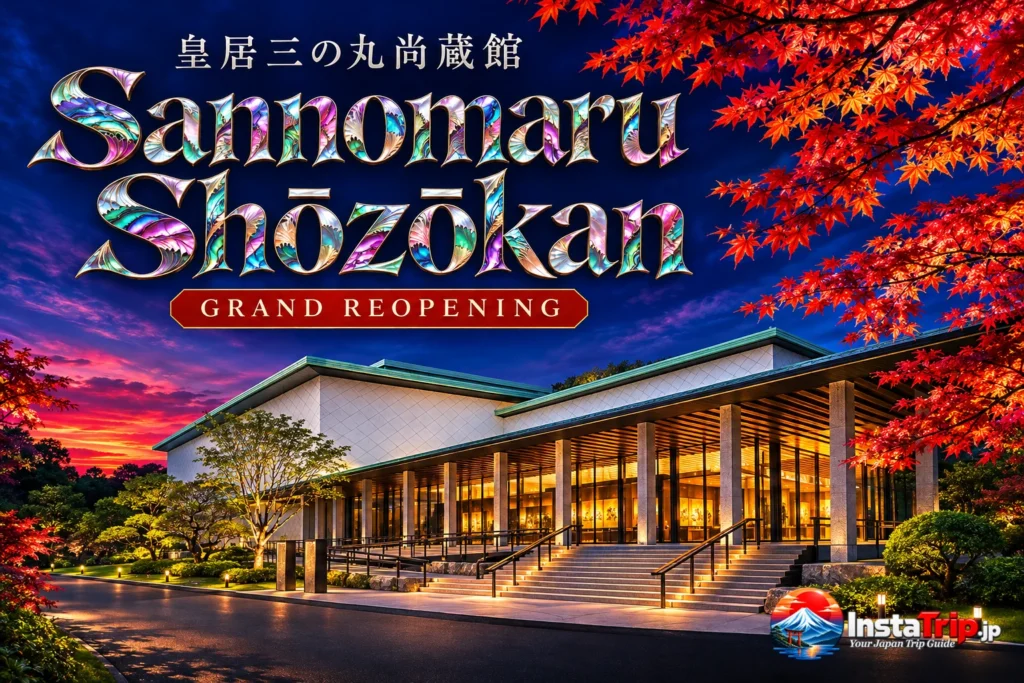
Just inside the Ōte-mon gate, past the stone walls of Edo Castle, is a collection that lets you travel through centuries of Japanese art in a single visit. At the Sannomaru Shozokan (皇居三の丸尚蔵館), a silk painting by Itō Jakuchū can share an exhibition with a mother-of-pearl lute preserved at the Shōsōin. A few weeks later, an entirely different set of works takes their place.
The Museum of the Imperial Collections fully reopened on November 3, 2026, after a partial opening in 2023 and the completion of its expanded building. Its inaugural exhibition runs through January 24, 2027, in three rotations. Choose the artworks you want to see before you reserve a time, and check which palace gate will be open on your visit date. Official exhibition details
Plan your visit. Exhibitions and dates · Tickets and hours · Entrances and map · Jakuchū in 2027
What reopened inside the Imperial Palace East Gardens?
Sannomaru (三の丸) is the third bailey of former Edo Castle, where the museum stands today. The institution began with paintings, calligraphy, decorative arts and historical materials donated to the nation in 1989 by the present Emperor Emeritus and Empress Kōjun. It opened to the public in 1993. The expanded facility gives the museum more room to show, store and care for the collection, and the opening exhibition uses all three galleries. Museum history

The setting gives the visit two distinct scales. Outside, the moat and castle walls tell a story in stone. Inside, much of the craftsmanship rewards an unhurried look at a few centimeters of silk, lacquer or paper. Allow an hour to 90 minutes for the galleries, with more time if you plan to walk through the gardens.
Beauty Through the Ages and its three rotations
Beauty Through the Ages: Treasures of the Imperial Collections (皇室の至宝―美いづるところ) brings together works from the museum with pieces from the Shōsōin (正倉院) and the Hōryūji treasures (法隆寺献納宝物). The museum changes the full selection between rotations. The dates below help you pick a visit around a specific work. See the museum’s selected works and display dates
| On view | Highlights to look for | Booking opened or opens |
|---|---|---|
| Nov. 3–23, 2026 | A red sandalwood biwa with mother-of-pearl inlay, Kanō Tan’yū’s Scenes from The Tale of Genji, and Itō Jakuchū’s Phoenixes and the Rising Sun. | Sept. 12, 2026 |
| Nov. 26–Dec. 20, 2026 | A 17th-century Map of the World and Renowned Cities and Tomioka Tessai’s Earthly Paradise and Sacred Mountains. | Nov. 11, 2026 |
| Dec. 23, 2026–Jan. 24, 2027 | The right-hand Chinese Lions screen by Kanō Eitoku and volume one of the Illustrated Account of the Mongol Invasions. | Dec. 2, 2026 |
Tickets go on sale at 10 a.m. Japan time on each release date. If the first rotation is still on when you arrive, look closely at the biwa. The pale shell inlay stands out against the dark wood, an intimate detail even in a room of larger works. In the third rotation, give yourself time for both the monumental folding screen and the medieval handscroll, which tells its story a section at a time. Official booking calendar
Sannomaru Shozokan tickets and opening hours
General admission for the inaugural exhibition is ¥2,500. Reserve a 30-minute arrival window online through ART PASS. That window is when you enter, and you can continue through the galleries after it ends. The museum has no walk-up ticket sales for this show. If you’re choosing a slot on the day, check online availability before heading to the palace. Check availability and reserve through the museum

Visitors under 23 and students at university, high school or junior high school can reserve free tickets with proof of eligibility. Elementary-school-age children and younger enter free with a parent or guardian and do not need a reservation. Visitors with qualifying disability documentation and one companion can also enter free without a reservation. See eligibility and ID requirements
The museum normally opens 9:30 a.m.–5 p.m., with last entry at 4:30 p.m. On Fridays and Saturdays it stays open until 8 p.m., with last entry at 7:30 p.m. Most Mondays are closed. During the inaugural show, November 23 and January 11 are exceptions. Factor in the gallery changeovers and the December 28–January 3 year-end closure when planning a short stay. Check the museum calendar for your day
Getting to Sannomaru Shozokan and choosing a gate
The museum is at 1-8 Chiyoda, inside the Imperial Palace East Gardens (皇居東御苑). On a normal day, head for Ōte-mon (大手門), about five minutes on foot from Ōtemachi Station exit C13a or 15 minutes from the Marunouchi North Exit of JR Tokyo Station. The museum is about 100 meters beyond the gate. Allow time for the security bag check. Official directions and gate map
November 28–December 6, 2026 access change. During the daytime opening of Inui-dōri, Ōte-mon is exit-only for museum visitors. Enter via Hirakawa-mon (平川門) or Kita-Hanebashi-mon (北桔橋門). Takebashi Station exit 1a serves both gates. The last daytime museum slot is 2:30–3 p.m., and the two gates close at 3:30 p.m. For evening visits on November 28, December 4 or December 5, use Ōte-mon from 5 p.m. Check the museum’s notice before leaving your hotel. Read the entry restrictions
Open the museum in Google Maps · Walk from Tokyo Station to Ōte-mon
When to see all 30 Itō Jakuchū scrolls
Save February 4–March 14, 2027 for Sacred Garden of Birds and Flowers. The museum plans to present the complete 30-scroll Colorful Realm of Living Beings (動植綵絵) by Itō Jakuchū (伊藤若冲), the first full showing since the series was designated a National Treasure in 2021. Other works in the exhibition will rotate. See the Jakuchū exhibition details
Jakuchū’s subjects include fish, insects and flowers as well as birds. In Mandarin Ducks in Snow, he applied white pigment on both sides of the silk, giving the flakes a different sense of depth. When you stand in front of one of the scrolls, start with a detail and then step back to see how it changes your reading of the whole image. Explore the series at the National Gallery of Art
From March 25 to May 16, 2027, the third opening exhibition, Japanese Calligraphy: A 1,300-Year Legacy of Beauty (日本の書の美1300年), traces the form from the Nara period to modern Japan. The first selection runs March 25–April 18 and the second April 21–May 16. See the full exhibition schedule
A half-day around the museum
For art and gardens, pick a morning or early afternoon slot on a day when both are open. After the galleries, walk toward Ninomaru Garden (二の丸庭園) for the pond and trees, then return toward Marunouchi for lunch. The East Gardens are free. From November through February their regular hours end at 4 p.m., with last entry at 3:30 p.m. East Gardens hours and map
For a Friday evening, start with the museum and finish with dinner near Tokyo Station. The East Gardens are ordinarily closed on Fridays, but the museum admits its visitors through Ōte-mon. If you’re stopping briefly between trains, leave a large suitcase in a station locker before coming to the palace. Explore more museums in Tokyo
Two books for a closer look at Japanese art
As an Amazon Associate, InstaTrip.jp earns from qualifying purchases.
Colorful Realm, edited by Yukio Lippit. The National Gallery of Art’s 2012 exhibition catalogue is the place to start if you want to see the 30 scrolls in detail and learn how Jakuchū built up color on silk. Find Colorful Realm on Amazon
Japanese Art by Joan Stanley-Baker. A compact survey for putting the museum’s painted screens, calligraphy and decorative arts into a longer history. Find Japanese Art on Amazon
Sannomaru Shozokan FAQ
Do I need a separate Imperial Palace tour booking?
A museum reservation is all you need for your gallery visit. The museum is inside the East Gardens, which have their own access hours. The guided Imperial Palace tour has a separate entrance and booking system. See the two entrances on the palace map
Can I visit with a wheelchair or stroller?
The museum galleries accommodate wheelchairs and strollers. Check the gate and approach for your date, especially during temporary access changes. Large luggage stays outside the museum, so plan to store it at your hotel or station. Museum visitor guidelines
What should I do if I want to see one particular artwork?
Check that work’s dates on the exhibition page, then book within its rotation. The full 30-scroll Jakuchū exhibition starts in February 2027 with its own admission arrangements. Check the official exhibition schedule