
Taira no Masakado: The Samurai Curse Hidden Beneath Modern Tokyo
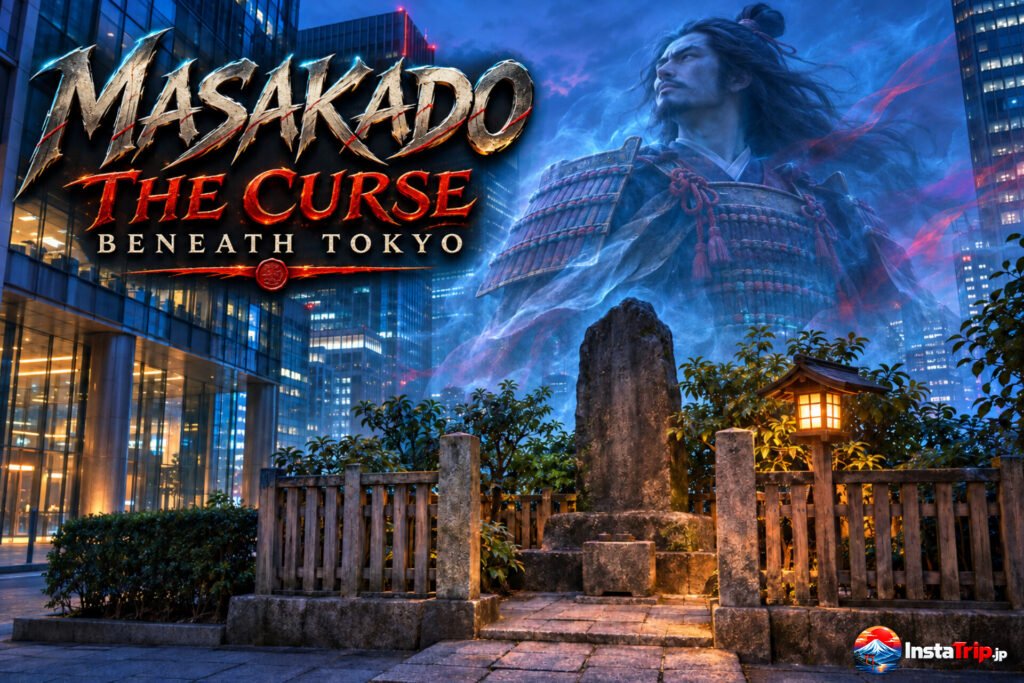
Tokyo’s Otemachi district is built to project certainty: polished stone, glass towers, banks and corporate headquarters. Yet at 1-2-1 Otemachi, a few minutes from the Imperial Palace, one small memorial interrupts that confidence.
This is Masakado-zuka (将門塚), also called Masakado no Kubizuka (将門首塚)—the head mound of Taira no Masakado (平将門). Tradition says it marks the place where the severed head of a tenth-century rebel warrior finally came to rest after flying hundreds of kilometers back from Kyoto. Later stories warn that disturbing the mound brings misfortune.
The supernatural claim is folklore, not verified fact. The monument, the warrior and the centuries of ritual surrounding him, however, are real. The tension between those layers is what makes this quiet corner of Tokyo so compelling.
The mystery in one minute
- Historic figure: Taira no Masakado, an eastern warrior who challenged the Heian court
- Rebellion: Escalated in 939; Masakado was defeated and killed in 940
- The site: Masakado-zuka, Otemachi, Chiyoda City, Tokyo
- The legend: His displayed head flew east from Kyoto and landed here
- Religious legacy: Pacified through Buddhist rites and later enshrined at Kanda Myojin
- Modern status: Tokyo-designated historic site, renovated for the sixth time in 2021
Who was Taira no Masakado?
Taira no Masakado was a provincial warrior of the mid-Heian period (平安時代, 794–1185) and a descendant of Emperor Kanmu through the Taira line. A traditional chronology gives 903 as his birth year, although the exact year is uncertain.

His story did not begin as a supernatural tale. It began with disputes among powerful landholding families in eastern Japan. From 935, those conflicts grew into a series of armed confrontations. In 939, Masakado seized the provincial government headquarters of Hitachi and then took control of other administrative centers in the eastern provinces.
According to the surviving chronicle Shomonki (将門記), he eventually assumed the title Shinnō (新皇), or “New Emperor.” The challenge was brief. Forces led by Fujiwara no Hidesato and Masakado’s kinsman Taira no Sadamori defeated him in Shimōsa in 940. His head was then carried to the capital, Heian-kyō—present-day Kyoto—and publicly displayed.
Historians view the rebellion as an important early moment in the rise of the provincial warrior class. The Cambridge History of Japan describes it as a development that anticipated the growing political importance of professional warriors.

The head that refused to remain in Kyoto
Here history passes into legend.
The official Chiyoda tourism account preserves a dramatic version of the story. Masakado’s head, displayed at Shichijō-gawara in Heian-kyō, supposedly continued to open its eyes and demanded to be reunited with its body. Driven by resentment, it rose into the air and flew east toward its homeland.
One tradition says it fell at what is now Otemachi. The place became known as a kubizuka (首塚)—a mound associated with a severed head. This is not evidence that a head literally flew across Japan, nor has archaeology established that Masakado’s remains lie beneath the present monument. It is a legend attached to a real site of remembrance.
That distinction matters. Treating the tale only as a ghost story misses why the site survived for so long.

From rebel to onryō—and then guardian
Masakado’s image changed repeatedly after his death. To the imperial court, he had been a rebel. In later popular belief, he became an onryō (怨霊), a powerful spirit whose anger could cause calamity if neglected. To many people in eastern Japan, however, he also became a heroic figure who resisted distant authority and defended the weak.
Kanda Myojin’s own history says that, after the mound deteriorated and troubling events were blamed on Masakado’s spirit, the Jishū Buddhist monk Shinkyō Shōnin (真教上人) performed rites for him in 1307. The monk bestowed the posthumous Buddhist name Ren Amidabutsu (蓮阿弥陀仏) and restored the memorial. In 1309, Masakado was enshrined at nearby Kanda Myojin (神田明神).
Today Kanda Myojin officially presents Masakado as one of its three enshrined deities and as a protector who wards off evil. The feared spirit and the protective deity are therefore not two unrelated characters; they are stages in the same long cultural transformation.
The mound Tokyo kept rebuilding
Masakado-zuka did not remain untouched for a thousand years. Its form, surroundings and caretakers changed as Edo became Tokyo.
- 1616: Kanda Myojin moved to its present location as Edo Castle expanded, while the mound remained in Otemachi.
- 1906: Supporters of Masakado’s rehabilitation erected a preservation monument on the Finance Ministry grounds.
- 1923 and after: The Great Kantō Earthquake destroyed the surrounding government buildings, and the old mound was leveled during reconstruction. Memorial structures and rites continued.
- Postwar period: Local custodians and neighboring organizations worked to prevent the site from disappearing during redevelopment.
- 1960–1961: The Historic Masakado-zuka Preservation Society was organized and began a series of restoration projects.
- 1971: The site received designation as a historic place by the Tokyo Metropolitan Government.
- 2021: A four-year project culminated in the sixth renovation, improving access, ventilation and the setting for prayer.
The central stone stele visitors see today is also not an untouched tenth-century artifact. Kanda Myojin explains that it was reconstructed in 1970, using wording derived from a rubbing associated with the older memorial tradition.
The bulldozer story: record, coincidence or curse?
The most famous modern episode occurred after World War II. According to the Historic Masakado-zuka Preservation Society’s own account, the former Finance Ministry site was being cleared for use by the occupation authorities when a bulldozer overturned near the buried memorial. Its operator later died from his injuries.
Local resident Endō Masazō recognized the surviving stone marker and petitioned the occupation authorities to stop the demolition. The mound was spared, temporarily fenced and cared for until a formal preservation organization was created.
The accident is part of the preservation society’s recorded history. Calling it supernatural causation is an interpretation, not a demonstrable conclusion. Yet the story shows how belief can alter the physical development of a city: whether one fears a curse, respects a sacred place or values cultural memory, the result is the same—the monument remains.
Why frogs once surrounded the monument
Older photographs of Masakado-zuka often show small frog figures. The reason is a Japanese wordplay: kaeru (蛙) means “frog,” while kaeru (帰る) can mean “to return.” Because Masakado’s head was said to have returned east, visitors offered frogs while praying for a transferred employee, traveler or missing loved one to return safely.
Do not assume that old practices remain permitted. After the 2021 redesign, visitors should follow the current signs and avoid leaving figurines, food, incense or personal objects unless explicitly authorized.
Visiting Masakado-zuka respectfully
- Name: Masakado-zuka (将門塚) / Masakado no Kubizuka (将門首塚)
- Address: 1-2-1 Otemachi, Chiyoda City, Tokyo
- Nearest station: Otemachi Station; the official Chiyoda guide recommends Exit C5
- Admission: No admission charge is listed
- Best combined with: Kanda Myojin, Ochanomizu, Kanda and the Imperial Palace area
This is not a horror attraction. It remains an active place of remembrance and prayer maintained by a preservation association, shrine clergy, a Buddhist temple and neighboring organizations. Keep your voice low, do not block office workers or worshippers, do not climb on the stones and follow all posted instructions.
Kanda Myojin is the natural second stop. The shrine is approximately five minutes on foot from JR Ochanomizu Station or seven minutes from JR Akihabara Station, and Masakado is enshrined there as Masakado-sama (将門様). The contrast is revealing: at Otemachi, he is remembered through a head mound; at Kanda Myojin, he is approached as a protective deity.
History, belief and the city above it
Masakado-zuka is fascinating because no single label explains it. It is a memorial to a real warrior, a setting for a flying-head legend, a Buddhist site of pacification, part of Kanda Myojin’s sacred geography and a surviving pocket of cultural memory inside modern Tokyo.
It also reveals something deeper about the city. Tokyo is often described as a place that replaces itself endlessly. Here, however, redevelopment bent around memory. The small stone precinct did not defeat the skyscrapers. It simply remained among them.
If the subject interests you, continue through InstaTrip’s Kitsune (狐) legends and the story of Jizō (地蔵) and the mysterious Sanzu River.
Books for going deeper (paid links)
- The First Samurai: The Life and Legend of the Warrior Rebel, Taira Masakado by Karl F. Friday
- The Book of Yōkai by Michael Dylan Foster
- Japanese Ghosts and Demons: Art of the Supernatural
Frequently asked questions
Is Taira no Masakado’s head really buried at Masakado-zuka?
The site is traditionally described as the place where Masakado’s head was enshrined, and both Kanda Myojin and the official Chiyoda tourism guide preserve that tradition. There is no conclusive archaeological proof that the remains are beneath the present monument.
Is the Masakado curse real?
The curse belongs to folklore and religious belief. Several accidents and misfortunes have become attached to the mound’s story, but they do not establish supernatural causation.
Can visitors enter Masakado-zuka?
The official Chiyoda tourism guide presents it as a public historic site. Access can be affected by ceremonies, maintenance or local instructions, so observe signs and respect worshippers.
What does onryō mean?
Onryō (怨霊) means a vengeful or resentful spirit. In Japanese religious history and storytelling, rituals may calm such a spirit, which can then be remembered as protective rather than destructive.
Sources and further reading
- Chiyoda City Tourism Association: Masakado’s Tomb
- Kanda Myojin: Masakado-zuka history and annual rites
- Kanda Myojin: English history and enshrined deities
- Kanda Myojin 1300th Anniversary Project: sixth renovation completed in 2021
- Historic Masakado-zuka Preservation Society: chronology
- Historic Masakado-zuka Preservation Society: preservation history